My Role
Senior Product Designer
Project Duration
2 weeks
Platform
Mobile (iOS Prototype)
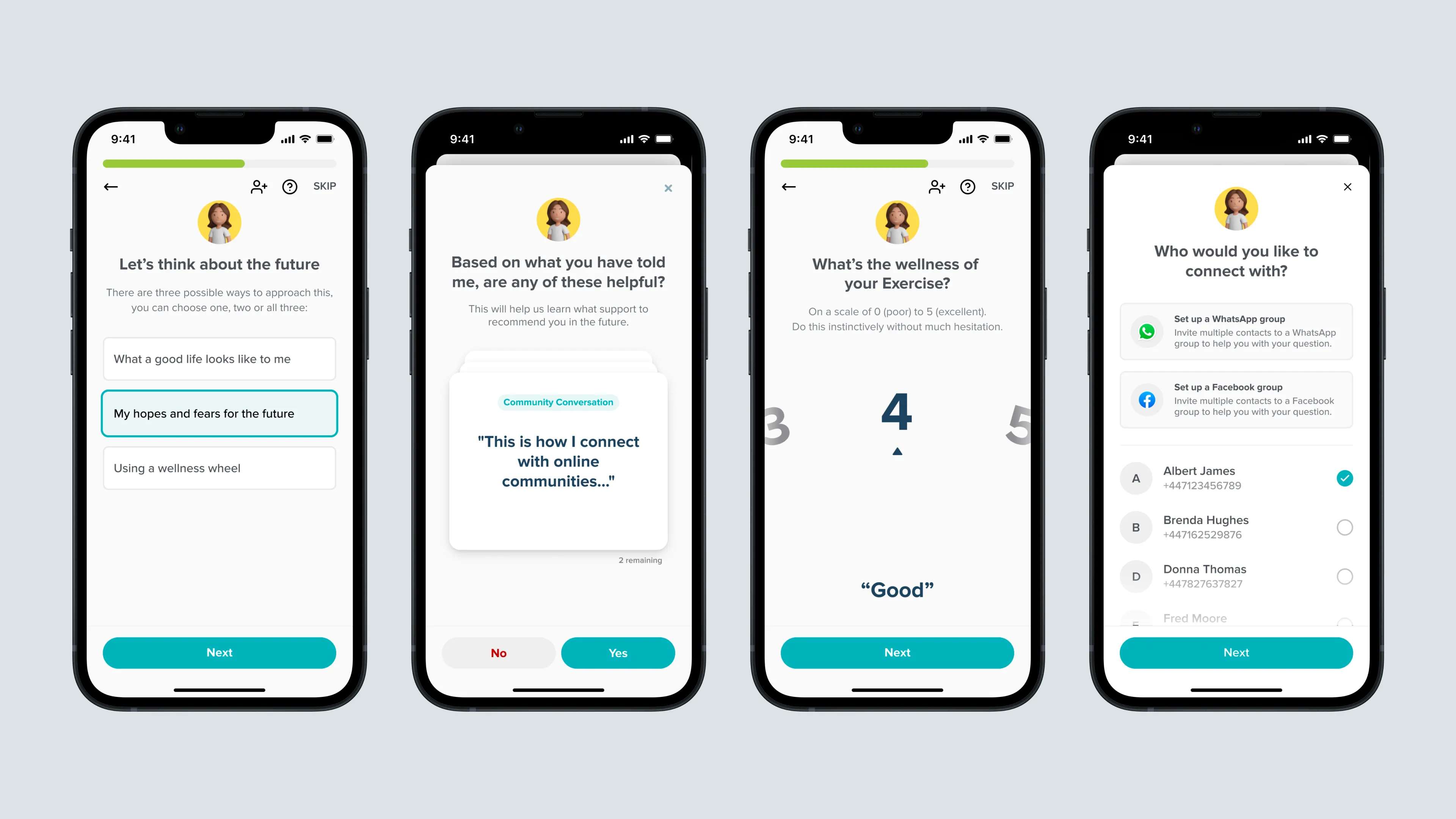
We collaborated with industry experts in a strategic exploration into how AI could transform care planning, collaborating with healthcare professionals to develop and validate high-fidelity prototypes. This conceptual work helped stakeholders envision the future of personalised care delivery.
Problem
Currently, people searching for care and support rely on a range of online directories and services to find options like care homes, agencies, individual providers, or community groups.
However, this process often assumes users know exactly what help they need.
For example, a wife caring for her husband with newly diagnosed dementia may not know where to begin when seeking support for both her husband and herself. Typically, this requires multiple conversations with healthcare professionals, as it’s difficult for people to seek out specific help when they don’t know what’s available.
Why Is This Important?
We didn’t want Tribe to be just another online directory. We aimed to create a platform that would actively help users discover personalised, holistic care and support solutions based on their unique story.
By engaging with the platform, users would not only receive personalised recommendations, but also contribute valuable data that could refine and enhance the platform’s ability to serve others. Our goal was to empower users through AI-driven, strength-based approaches, allowing them to plan for a future that aligns with their aspirations while supporting their well-being.
My Role
As the sole designer, I led the end-to-end design process, from user experience to interface design. I participated in workshops and discussions with both stakeholders and healthcare professionals, ensuring the prototype met the needs of end-users and aligned with the strategic goals of the project.
Strategic Objectives
Care Reimagined
Explore the potential of Machine Learning and Artificial Intelligence in a health and social care context.
User Validation
Test user and professional reactions and thoughts on AI-generated care suggestions.
Prototype Showcase
Develop a prototype that demonstrates how AI could support personalised care planning.
Core Research Questions That Guided Our Sprint
Proactive Care
How can we encourage people to engage proactively with support systems?
Care Innovation
How can we inspire users to explore new possibilities for their care?
Trust Building
How do we balance automation with a human touch to ensure confidence and trust in AI-driven solutions?
These questions helped frame our approach to a complex challenge, encouraging proactive engagement with care planning through AI while maintaining the human touch essential to healthcare.
Each question pushed us to balance innovation with empathy.
Key Implementation Challenges We Faced
Time Constraints
The two-week sprint required rapid iteration and quick decision-making, making it essential to focus on the core ideas without getting bogged down in details.
Co-Creation with Healthcare Workers
Traditional care conversations are hands-on and paper-based, translating this process into a digital experience was a significant challenge.
Trust in AI
People are accustomed to receiving health-related advice from professionals, not machines. We had to carefully consider how AI suggestions would be received in such a sensitive area.
Digitising a Physical Process
We needed to ensure that the digital process retained the personal touch of in-person conversations while benefiting from AI’s efficiency and personalisation.
While the two-week sprint offered exciting opportunities to innovate, it also presented several significant challenges. Each required careful consideration to ensure our solution remained both technically viable and genuinely helpful to users.
Our discovery phase combined workshops with social prescribers, analysis of existing care planning workflows, and extensive stakeholder interviews. This helped us understand:
Care Craft
How care professionals currently make personalised recommendations.
Amplified Care
Where AI could augment rather than replace human decision-making.
Care Assurance
Key trust barriers around AI in healthcare settings.
We designed a three-stage conversation flow that balanced AI capabilities with human needs:
Understanding the User
Generating Suggestions
Planning
While two weeks isn’t a lot of time, the sprint allowed us to rapidly iterate and test new ideas in a completely fresh area.
One of the key learnings was how AI can enhance proactive care planning, but it also highlighted the challenges of building trust in AI-driven solutions.
Stakeholders were generally positive about the concept, especially how it managed to balance personalisation with automation.
However, one key piece of feedback was that the process felt too long. In the future we would focus more on breaking up the conversation into smaller, manageable parts, allowing users to engage over time rather than in one long session.
The sprint provided a valuable opportunity to explore how ML and AI could change the way people plan for care and support in the UK.
While it was a conceptual project, it laid the foundation for future iterations, where we could explore how to integrate AI-driven suggestions into the existing Tribe platform and improve user engagement with more personalised, strength-based care solutions.